This article is general information for our patients, not a diagnosis. If something in your mouth hurts, changes, or worries you, have it examined.
Few things are harder to watch than your own child white-knuckled in a waiting room. Here is the reassuring part: children aren’t born afraid of the dentist. The fear is learned, and a fear that was picked up can usually be put down again. This guide, part of our Child Patient Information library, covers where it tends to come from, what to say at home, and how we work to make a visit feel safe.
One thing first, because parents read these lists and start diagnosing. The signs below are clues, not verdicts. A sore tummy on its own can be a dozen things; what points toward dental fear is the pattern — several signs, tied to the visit — read together with how your child responds once we begin. No single clue settles it, and that reading-together is something we do with you, not something to land on at home.
Where the fear comes from
Dental fear (dentists call it dental anxiety) tends to be learned rather than built in, and it usually arrives by one of two routes. The direct one: a single rough visit, especially one with pain, can teach a child that the chair is where bad things happen. The quieter one: children are expert readers of the adults they trust, so they catch fear by watching (psychologists call this modelling) — a parent who grips the armrest or retells their own dreaded root canal at dinner may be teaching without meaning to. Temperament matters too: shy or quick-to-frustrate children often find the chair harder than easygoing ones.
It feeds on itself, which is why I push to catch it early: a fearful child avoids the dentist, small problems grow, the eventual treatment is longer and harder, and the fear gains another layer of proof. It isn’t rare — about one in seven children (roughly 15 percent) struggles with dental fear, by the American Academy of Pediatric Dentistry’s estimate. And if this is your child, you’ve done nothing wrong; fear is a normal response in a small person facing a strange room of unfamiliar noises and smells, and nervous kids are part of every day here.
How a scared child shows it without saying it
Most children won’t say they’re scared; the worry shows up in the body and behaviour instead. The first thing I ask parents about is what changed in the day or two before — because one clue I rely on is timing: signs that cluster around the visit point toward dental fear more than the same signs scattered through an ordinary week. Common ones:
- A sore tummy or a sudden need for the toilet just before you leave
- Going silent, or a stutter that isn’t usually there
- More thumb-sucking or nail-biting than usual
- The same question on a loop (“Will there be a needle? But will there?”)
- Stalling — a lost shoe, a forgotten toy, a very slow breakfast
- Crying or clinginess that seems to come from nowhere
What looks like misbehaviour in the chair is usually fear that has run out of other ways to show itself. But no single item here is proof — a sore tummy can be a bug, a quiet child can just be tired. It’s the pattern, read together with how your child settles once we start, that tells us how much help they’ll need. Mention what you’ve noticed when you book, and we’ll shape the visit around it.
What to say before a visit — and what to skip
Keep it short, honest and casual, and never promise that something “won’t hurt.” That one surprises parents, because it’s said with love — but young children don’t process the “won’t”; what lands is the word hurt, and now they’re wondering why you brought it up. Same goes for “be brave,” “don’t worry,” and “it only stings for a second.” Keep hurt, pain, pinch, sting, needle and drill out of it, and announce the visit the way you’d announce a haircut.
| Instead of… | Try… |
|---|---|
| “Don’t worry — it won’t hurt.” | “The dentist is going to count your teeth and check how strong they are.” |
| “Be brave. It only stings for a second.” | “You can ask Dr. Nick any question you like.” |
| “If you don’t brush, the dentist will pull your teeth out.” | “Let’s brush so you can show Dr. Nick how strong your teeth are.” |
| “No, no needles, I promise.” | “Great question. Let’s ask the dentist together when we get there.” |
A few things that genuinely help:
- Never use us as a threat. “The dentist will pull your teeth out” turns the chair into a punishment, and a child who expects punishment arrives braced for one.
- Don’t answer questions you can’t control. If your child asks whether they’re getting a needle, don’t guess and don’t promise — hand it to us, and we’ll answer honestly in words built for their age. A broken promise costs more trust than an honest answer ever does.
- Model calm, and save rewards for afterwards. Your child borrows your mood in the waiting room, so keep your own dental stories private. A prize promised in advance signals something unpleasant is coming; praise right after lands better.
- Practise at home, and book little ones early. Count a teddy’s teeth or take turns being the dentist — children copy other children well — and a rested child copes better than a tired one at 4 p.m.
How we work in the chair
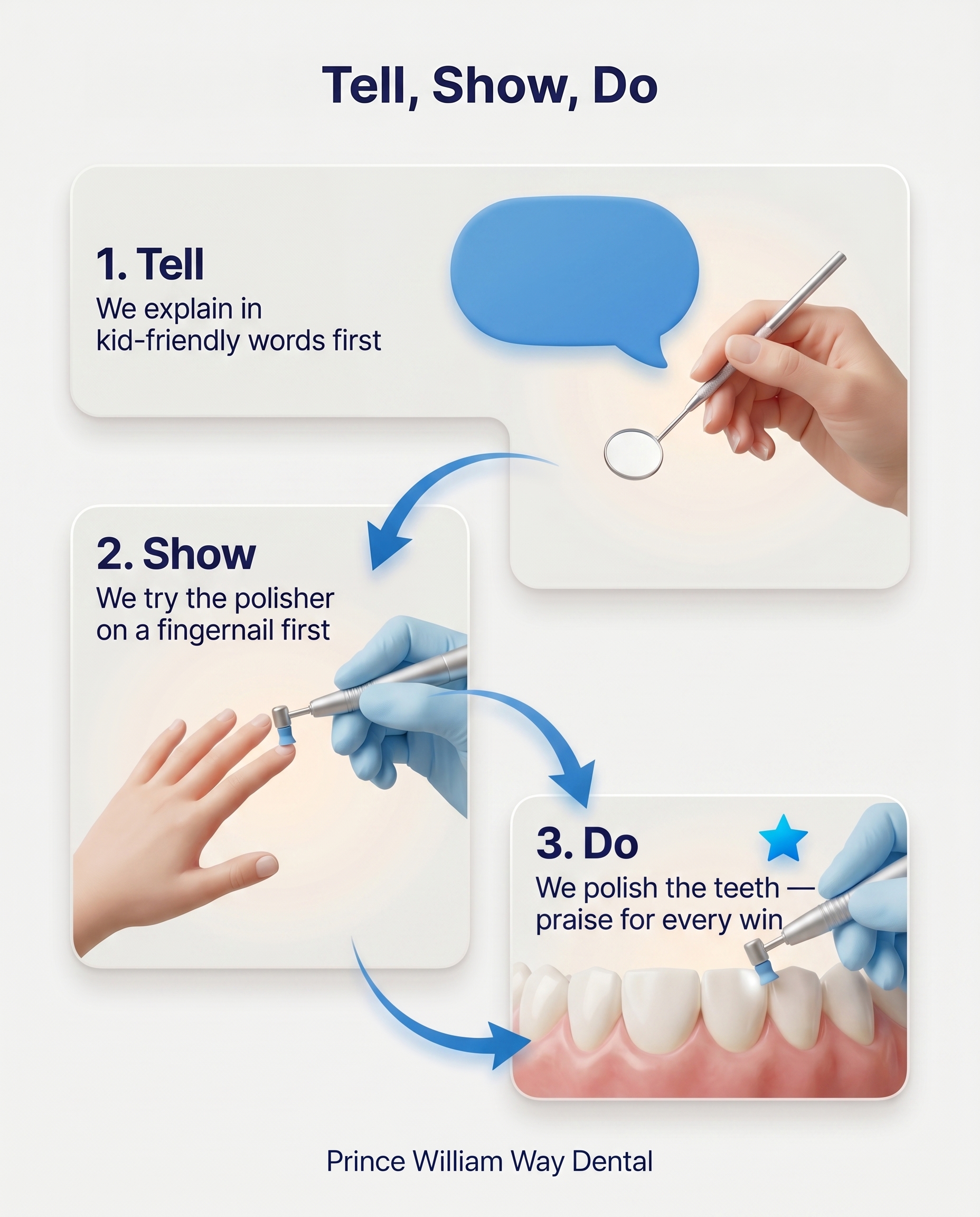
The backbone of children’s dentistry is tell-show-do. We tell your child what’s about to happen in words built for their age, no surprises; we show — the polisher gets demonstrated on a fingernail so they feel the tickle before it goes near a tooth; then we do, right away, before worry has time to build, with praise after each step. Even the equipment gets friendlier names: the polisher is a tooth tickler, the suction a little vacuum, the numbing gel sleepy jelly.
Around that we layer a few tools, all aimed at giving your child back a sense of control:
- Choices that don’t matter. “Blue sunglasses or purple?” “Climb up or jump up?” Small decisions, freely made, remind a child they’re a participant, not a passenger.
- A stop signal. Your child raises a hand and everything pauses — every time, no exceptions. Once children trust it works, most stop needing it.
- Two house rules: never lie, never surprise. A child who’ll feel pressure hears “you’ll feel me pushing now” before they feel it, and a hard question gets an honest answer at their level.
- Your child’s pace. Easy wins first — a chair ride, counting teeth, a polish — then we move up only once they’re relaxed at the current step (a gradual approach dentists call desensitization). Some settle in one visit, others need three; both are normal.
You’re welcome in the room throughout. The role that helps most is the calm, quiet supporter, close enough to hold a hand, while we keep one voice guiding the appointment.
Why starting early helps
Short, easy visits beginning around the first birthday put familiarity before difficulty: the chair, the sounds and the faces become routine long before any real treatment is needed. The Canadian Dental Association recommends a first visit within six months of the first tooth or by the first birthday, whichever comes first — and at that age there’s almost nothing to treat, so the visit is mostly counting, looking and stickers. A child who banks easy, positive visits early tends to be far less likely to develop lasting fear from a single bad moment later, and early visits catch problems while they’re small. I cover what those appointments look like in your child’s first dental visit and growing teeth; children who grow up comfortable in the chair tend to become teenagers who take x-rays, fillings and even braces and orthodontics in stride.
If there’s already been a bad visit
A bad experience doesn’t have to be the last word — we rebuild trust gradually, often starting with a visit where nothing is done at all. First, no blame: difficult visits happen even in careful hands, and a child who came away frightened isn’t “being dramatic.” Their fear is a reasonable conclusion, and our job is to give them new evidence. Tell us the story when you book — what happened, what was said, which words or sounds set your child off. We often start with what I call a “nothing visit”: your child rides the chair up and down, has their teeth counted, picks a sticker, and leaves. That small win is the foundation everything else is rebuilt on, and we climb one comfortable step at a time from there. With older children we talk about the bad visit openly; explaining what will be different usually lowers their shoulders an inch.
Booking a nervous child
Call us at 705-721-9229 and say the words “my child is nervous.” That single sentence changes everything: a morning slot, a slower pace, a team that leads with the tooth tickler and stickers, and nothing sprung on anyone. There’s no judgement here, whatever has happened before — helping a frightened child leave proud of themselves is one of the better parts of this job. Call us, or book an appointment online, and we’ll take it from there.
Need to see a dentist? Call us at 705-721-9229.
New Patient or Dental Emergency? Book Online!