This article is general information for our patients, not a diagnosis. If something in your mouth hurts, changes, or worries you, have it examined.
Patients ask me for a number, and I understand why — “every six months” is easy to remember and easy to book. But the honest answer is that the right gap between cleanings is the one matched to your mouth, and that ranges more widely than most people expect: from every three months for some, to once a year for others. Below is how I think about where you sit, and why the six-month habit isn’t a rule.
A quick but important caveat before we go on. Nothing here is a diagnosis or a fixed prescription. Your recall interval isn’t something you can work out from a checklist — it’s set in the chair, once we’ve measured your gum pockets, checked where they bleed, gone through your history and cavity pattern, and sometimes taken an X-ray. Any single factor, like “I brush well,” is a clue rather than the verdict: on its own it can point one way and turn out to mean another once your gums have actually been measured. So use this to understand what nudges the number, not to settle on one yourself.
What actually sets the right interval?
Not the calendar — your risk. A professional cleaning does two jobs: it lifts off hardened tartar that no brushing can shift (the clinical name is calculus), and it’s the visit where we read how your gums and teeth are tracking and catch small problems early. How often you need that depends on how quickly trouble tends to build in your particular mouth.
Dentistry has moved, over the last twenty years, from booking everyone at the same fixed interval toward matching the interval to individual risk — the approach behind formal tools like the periodontal risk assessment (Lang and Tonetti, 2003). The principle is simple: see higher-risk mouths more often, and don’t drag lower-risk mouths in more than they need. Practically, that tends to sort people into three rough bands — roughly every three to four months at higher risk, around six months in the middle, and closer to nine to twelve months when risk is genuinely low. Where you sit isn’t fixed; it moves as your gums and habits change.

Is six months a rule, or a habit?
It’s a habit — a sensible, cautious default, but not a law built around your mouth. There’s no strong evidence that exactly six months is the right gap for every adult. A large UK trial (the INTERVAL study, 2020) followed adults over several years and found that, for people at low risk, longer gaps between check-ups didn’t leave them with worse gum bleeding or more tooth loss than six-monthly visits. That doesn’t mean everyone should stretch their visits — it means the interval should follow the risk, not a reflex.
The reassuring flip side is what regular, risk-matched care achieves. In a Swedish study that followed adults for thirty years, people who kept up good home care plus cleanings matched to their own risk lost, on average, well under one tooth each across three decades. Matched to the mouth, this works.
What raises how often you need a clean?
A handful of things reliably speed up how fast plaque, tartar and gum trouble build — and a few point the other way. These are clues that shift the interval, not verdicts on their own:
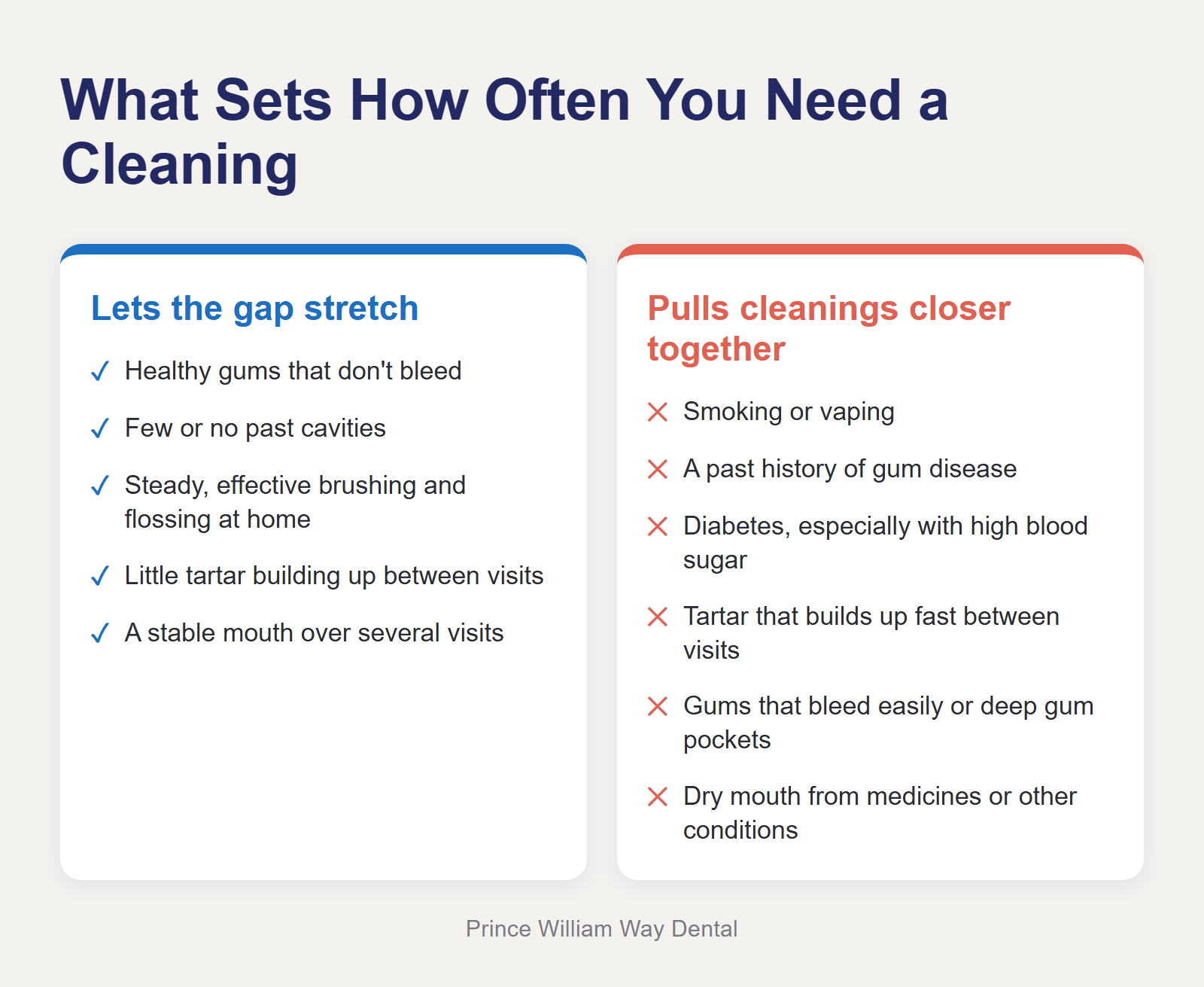
| Tends to pull cleanings closer together | Tends to allow a longer gap |
|---|---|
| Smoking or vaping | Healthy gums, no bleeding |
| A history of gum disease (periodontitis) | Low cavity history |
| Diabetes, especially if blood sugar runs high | Consistent, effective home care |
| Fast tartar buildup between visits | No fast tartar buildup |
| Gums that bleed easily, or deep gum pockets | Stable mouth over several visits |
| Dry mouth (from medicines or other conditions) | No plaque-trapping crowns, bridges or crowding |
None of these decides the interval by itself. Smoking with healthy-looking gums still shortens the interval, because the damage from smoking is often hidden — smokers tend to bleed less, so the usual warning sign is muted. That’s why your interval gets weighed from all your risk factors combined — history, gum readings, how fast tartar builds — rather than lifted from any single row above.
What if you’ve had gum disease?
Then more frequent cleanings usually earn their place — this is where the interval question matters most. Once gum disease has damaged the bone and tissue around teeth, the tendency for it to return doesn’t fully switch off; in periodontics there’s a saying that once you’ve had periodontitis, you’re always someone who needs to keep an eye on it. For most people who’ve been treated for it, that means a maintenance cleaning every three to four months rather than once or twice a year, so we can clear buildup below the gum line and check that things are holding before they slip.
This isn’t about selling extra visits — it’s the part that protects the treatment you’ve already had. Studies of gum-disease patients consistently show that those who skip regular maintenance lose noticeably more teeth over time than those who keep it up. If you’ve been treated for gum disease, how gum disease starts and how we treat it explains the maintenance side in more detail.
How often do children need a cleaning?
For most children with healthy teeth and good home care, a check-up every six months is a reasonable default — partly because children’s mouths change quickly and regular looks catch new cavities and bite changes early. As with adults, the interval flexes with risk: a child with several cavities, weak enamel, braces, or a high-sugar diet may need to be seen more often, while a low-risk child may safely stretch a little. If your child hasn’t been in yet, your child’s first visits walks through what to expect.
How often does the CDCP cover cleanings?
Here’s the distinction worth keeping straight: how often the CDCP covers a cleaning is a billing rule, and how often your mouth needs one is a clinical judgement — and the two don’t always line up. The Canadian Dental Care Plan does cover scaling and cleaning, but on a frequency set by the plan’s own rules rather than by your risk. For some people the covered frequency matches their need closely; for others — especially anyone on a three-to-four-month gum-maintenance schedule — clinical need may run ahead of what’s covered in a given period.
Because the plan’s coverage details and unit limits are the part people find most confusing, and they can change, I won’t put specific numbers here that might go stale — we keep those on our dedicated page, the Canadian Dental Care Plan explained, and our team will check your specific coverage for you. What I’d say clinically: if your mouth needs cleanings more often than the plan covers, that’s worth an honest conversation rather than quietly stretching the gap — we can talk through the options.
Are check-ups and x-rays covered too?
Yes — examinations and the x-rays we take with them are among the routine services the Canadian Dental Care Plan helps toward, on a frequency the plan sets rather than one you choose. The same distinction applies as with cleanings: the plan decides how often it will help toward a check-up or a set of x-rays, and I decide how often your mouth needs one. Most of the time those line up. When they do not, I would rather tell you plainly than quietly leave a gap. Our team checks your own coverage before we do anything and puts the position in writing. For who qualifies and how the plan works overall, see the Canadian Dental Care Plan explained, or call us at 705-721-9229.
What happens if you stretch it too long?
Nothing dramatic on day one — the risk is slow and quiet, which is the catch. Tartar keeps hardening in the spots a brush misses, its rough surface grips more plaque, and the gum around it stays irritated, so the longer it sits the harder the area is to keep clean. In a low-risk mouth a modest overshoot may cost little. In a higher-risk one, the gap is where gum disease quietly advances or a small cavity grows into a bigger one — problems that rarely hurt until they’re larger. That’s the real value of the visit beyond the polish: reading how things are tracking and catching the quiet ones early.
If it’s been longer than you meant, don’t let that keep you away — the fix is simply to come in, have a look, and reset the interval from where things actually stand.

So what’s the right answer for you?
Somewhere between every three months and once a year — and the way to find your number isn’t to guess from this page, it’s to have your gums and teeth looked at and set the interval together. We write it down, then revisit it as your risk changes: tighten it if your gums are struggling, ease it if things are stable. Good daily care between visits is what earns the longer gaps, so it’s worth getting that right too — how to clean your teeth well and why scaling matters covers the technique side.
This guide is part of our Adult Patient Information library, the plain-language set we keep on the everyday questions patients ask. To arrange a checkup and cleaning at Prince William Way Dental here in Barrie — evenings and Saturdays available, direct billing, and CDCP accepted — give us a call — or if you’re new to the practice, book your first visit and cleaning online — and we’ll settle the right routine for your mouth together.
Need to see a dentist? Call us at 705-721-9229.
New Patient or Dental Emergency? Book Online!