This article is general information for our patients, not a diagnosis. If something in your mouth hurts, changes, or worries you, have it examined.
Drafted with AI assistance and reviewed for accuracy by Dr. Nick Jadidi.
I spend part of almost every day watching how people clean their teeth, and the same thing keeps showing up: nearly everyone does something well, and one or two small habits quietly cancel out the effort. The fix is rarely brushing harder: it’s technique, and the one step most people skip. Good daily care comes down to brushing the bacterial film off your teeth twice a day and cleaning between them once a day; the rest is detail.
What am I actually cleaning off my teeth?
What you’re cleaning off is plaque: a sticky film of bacteria that reforms on clean teeth within hours, every day, for everyone. It drives both problems I treat most: the holes we call cavities and the gum inflammation we call gum disease. Fresh plaque is soft and wipes away easily; daily cleaning just removes it before it can damage a tooth or harden into something only an instrument can lift.
A word before the technique. A little blood in the sink or a rough ledge your tongue keeps finding is a hint about what your gums are up to; it is not the verdict on its own. The verdict only comes together in the chair, where I can pair what you tell me with a proper look at the gums, a gentle check of how they respond, and an X-ray when the deposits sit below the gum line. The same rough patch or spot of bleeding can mean one thing in a healthy mouth and something more in another. Let it guide how carefully you clean and when you book, not what you decide is wrong.
How should I brush my teeth properly?
Brush twice a day, for two full minutes, with a fluoride toothpaste, bristles angled toward the gum line in short gentle strokes. Two minutes is longer than it feels, so a timer keeps you honest.
The technique that works (the modified Bass method) is simple: tip the bristles to about 45 degrees where tooth meets gum, and use short back-and-forth or small circular movements, not long scrubbing sweeps. Work around in the same order each time so you don’t keep missing the same spots — usually the inside surfaces and the backs of the last molars. Let the bristles do the work; pressing hard cleans no better and wears the gum and tooth over time. A brush head splayed flat after a few weeks means you’re leaning too hard. Replace it every three months either way.
For toothpaste, an adult wants fluoride in the 1,000–1,500 ppm range — the number’s on the tube, and most family toothpastes qualify. A pea-sized dab is plenty; fluoride does the real cavity-prevention work, helping enamel resist acid and repair early damage. Children need less and closer supervision, which we cover separately in our children’s pages.

Should you rinse with water after brushing?
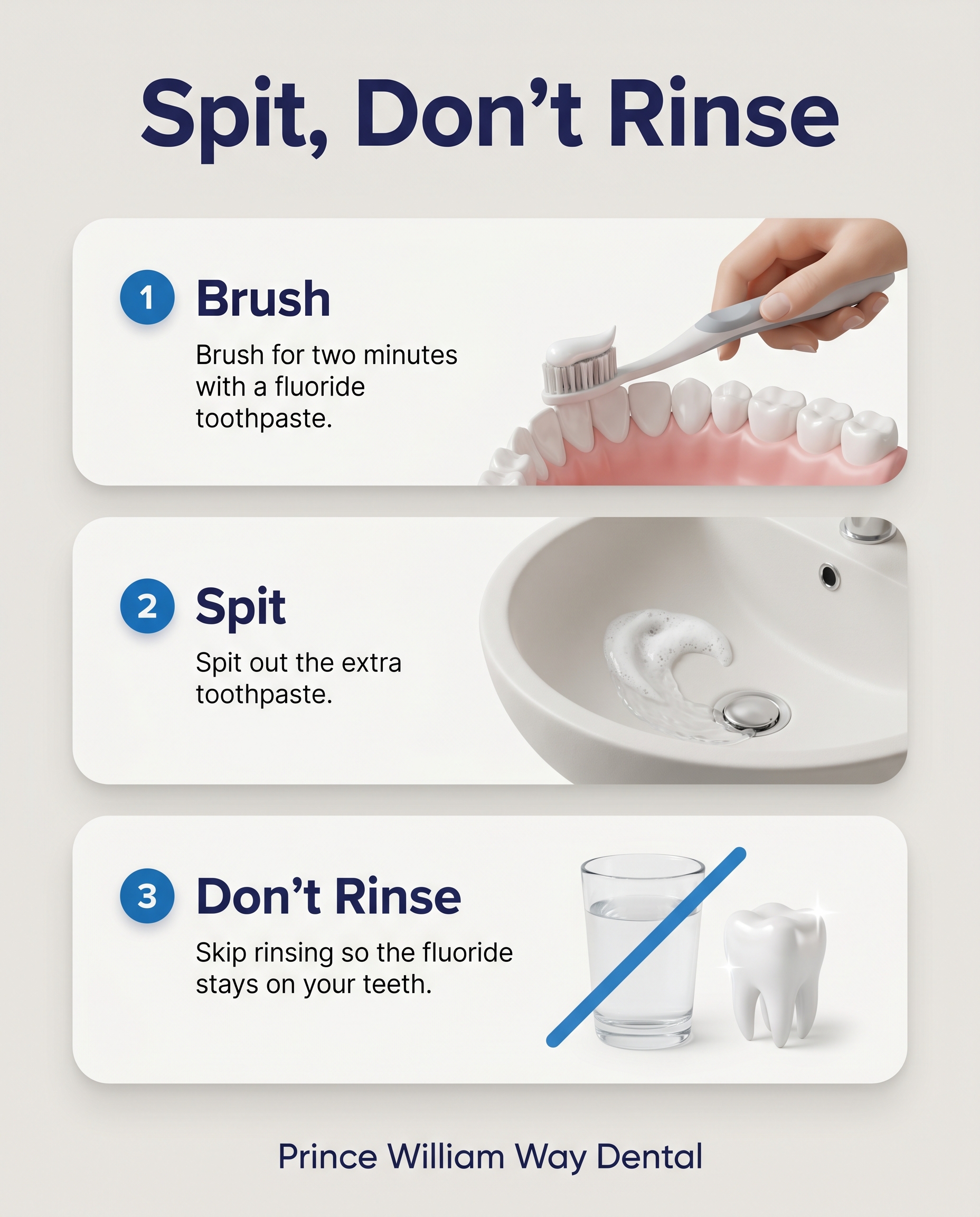
No: rinsing with water straight after brushing washes away the fluoride you just applied, so spit out the excess toothpaste and skip the rinse. Let that thin film of fluoride keep working. It matters most at night, when saliva flow drops and nothing else is guarding the teeth. If you like a fluoride mouthwash, use it at a different time (after lunch, say), not right after brushing.
Is an electric toothbrush better than a manual one?
A powered brush has a small, real edge; a manual brush used well still cleans perfectly. Technique and consistency matter far more than which one you hold.
I’d rather give you the evidence than a sales pitch. Pooled independent trials (a Cochrane review) put powered brushes at roughly 10–20% less plaque than a manual brush, with the larger gains after about three months, but that evidence is only moderate quality, and whether so small a difference changes your long-term health isn’t clear. So: if a powered brush helps you brush well, or its timer stops you rushing, it’s a sensible buy. If you prefer a manual and use it properly, you’re missing nothing essential. Either way, choose soft bristles; medium and hard offer no benefit and are rough on gums.
Interdental brushes or floss: which should I use?
Use a small between-teeth brush (interdental brush) wherever one fits, and floss where teeth touch too tightly for a brush — once a day, ideally in the evening. A toothbrush only reaches the front, back and biting surfaces; the hidden sides where teeth meet are where a lot of decay and gum disease quietly start.
The gaps themselves should decide your tool. Where there’s a little space at the gum, the tiny bottle-brush-shaped interdental brushes tend to remove more plaque than floss and are easier to use well, so interdental brushes versus floss isn’t really a contest where a brush fits. Where teeth sit tight with no visible gap, forcing one in does harm, and that’s where floss earns its place; its evidence alone is modest but real for calming gum inflammation. The catch is technique: a quick straight snap does little — curve the floss into a C against each tooth and slide gently under the gum line.
If your gums bleed a little when you start, that usually means they were already inflamed; keep going, gently (more below). Not sure which brush size fits? We’ll size them with you at a visit. This is the first habit I’d add if you’re skipping it — it ties into how gum disease starts and how we treat it and into how cavities form.
Does cleaning my tongue help with bad breath?
Cleaning your tongue usually does help: most everyday mouth odour comes from bacteria in the mouth, not the stomach, and a fair amount of it sits in the coating at the back of the tongue. Wiping that coating gently from back to front once a day, with your brush or a scraper, can make a real difference; you’re wiping the surface, not scrubbing it raw. Breath that cleaning doesn’t fix can be pointing at something else: gum disease, a hidden cavity, a dry mouth, occasionally the nose or throat. If it lingers, mention it and we’ll look for the source.
What is dental scaling, and why do I need it?
Scaling is the professional removal of tartar — plaque that has hardened on the tooth, above and below the gum line (its clinical name is calculus). Once plaque turns to tartar it bonds so firmly that no brushing or flossing will lift it; only an instrument can.
Leave plaque sitting in one spot and minerals in your saliva start turning it solid within a couple of days — you can often feel it as a rough ledge behind the lower front teeth, where it builds first. The trouble isn’t only the tartar; its rough, pitted surface grips fresh plaque and keeps the gum irritated, so the area gets harder to keep clean the longer it’s left. Removing it is a physical job for the right tools: fine hand scalers and an ultrasonic tip that uses high-frequency vibration and a water spray to break deposits off the tooth, reaching a little under the gum line where you can’t.
Even a careful scaling can’t reach every last trace below the gum line, and the bacteria start rebuilding within weeks, which is why the daily cleaning you do at home is what holds the result between visits. Home care stops new plaque building; scaling clears what’s already hardened. You need both. One thing I’d steer you away from is the scaler kits sold for home use: used blind, a scaler can gouge the root surface and push deposits deeper under the gum, so leave tartar below the gum line to the instruments in the chair.

How long will my teeth be sensitive after a scaling?
A day or two of mild sensitivity to hot and cold is normal after a scaling, and a fluoride toothpaste, or a sensitivity toothpaste if you’re prone to it, settles it fastest. It’s the most common question I get after a cleaning, so here’s the fuller picture: brushing as usual, twice a day, is what calms things down; there’s no need to switch to anything special or stop cleaning the area.
Why the sensitivity happens: tartar sitting against the gum keeps it a little swollen, and once we lift the tartar off, the gum shrinks back to health and can briefly leave the necks of the teeth more exposed. That usually settles within a week or two as the gum firms up.
If sensitivity is sharp, sticks to one tooth, lingers well past 30 seconds after the cold is gone, or is still climbing after a couple of weeks rather than fading, that’s worth a call; it points away from ordinary post-cleaning tenderness, and I’d rather look.
What should I do to look after my teeth after a scaling?
For the first day or two after a scaling, keep brushing gently with a fluoride toothpaste, go easy on very hot, very cold and acidic things, and let tender gums settle as they heal. A few plain-language pointers:
- Keep brushing, gently. Soft bristles, the same twice-a-day routine, and spit rather than rinse so the fluoride stays put. A fluoride or sensitivity toothpaste helps most.
- Go easy on very hot, very cold, and acidic things for a day if your teeth are tingly; it’s temporary.
- Tender or slightly puffy gums, and a little pink in the sink, are common if there was inflammation to begin with, and usually calm within a few days as the gum heals.
- Warm salt-water rinses (a teaspoon of salt in a cup of warm water) soothe sore gums if you want them.
Why do my gums bleed when they’re cleaned?
Gums that bleed during a cleaning are usually already inflamed by plaque — the bleeding reveals that, it isn’t caused by it. Healthy gums don’t bleed when cleaned properly.
It’s easy to read this backwards and decide the clean is too rough. What’s really happening is that plaque at the gum line has caused inflammation (the early, reversible stage we call gingivitis), and inflamed gums have fragile, swollen vessels near the surface that bleed at the lightest touch. The clean exposes the problem; it doesn’t create it. Once the tartar’s gone and you keep the area clean, the inflammation settles and the bleeding usually fades within a couple of weeks. So bleeding is a reason to clean more carefully, not to stop. How far it’s actually gone is something I read from the exam and sometimes an X-ray together, not from the bleeding alone, so gums that bleed often, even away from the dentist, are worth having checked. If it’s mainly your toothbrush drawing blood at home, we cover why gums bleed when you brush separately.
How often do you really need a cleaning?
There’s no single right interval for everyone — how often you need a professional clean depends on your own risk, so we set it with you. For most people it lands somewhere between every three months and once a year, and it isn’t fixed for life.
The idea that everyone needs a clean exactly every six months is a habit, not a rule built around your mouth. Healthy gums, low cavity risk and good home care can mean longer gaps; a history of gum disease, smoking, or fast tartar buildup can mean every three to four months. As your gums and habits change, the interval changes with them. The reassuring evidence: in a 30-year Swedish study, adults who kept up good home care plus cleanings matched to their own risk lost, on average, fewer than one tooth each across three decades. And at each visit we’re not only cleaning; we’re reading how things are tracking and catching small problems before they grow.
| Your situation | Typical cleaning interval |
|---|---|
| Healthy gums, low cavity risk, excellent home care | Every 9 to 12 months |
| Average risk, generally stable mouth | About every 6 months |
| History of gum disease, smoker, or fast tartar buildup | Every 3 to 4 months |
These are starting points, not rules: your interval is something we settle together, reading your history and how your gums respond as a whole, and adjust as things change. If you want the fuller picture, we walk through how often you need a dental cleaning on its own.
This guide is part of our Adult Patient Information library, the plain-language set we keep on the everyday problems we treat. To arrange a checkup and cleaning at Prince William Way Dental here in Barrie, give us a call — or if you’re new to the practice, book your first visit and cleaning online — and we’ll work out the right routine for your mouth together.
Need to see a dentist? Call us at 705-721-9229.
New Patient or Dental Emergency? Book Online!