This article is general information for our patients, not a diagnosis. If something in your mouth hurts, changes, or worries you, have it examined.
“Is fluoride good or bad for you?” is one of the fairest questions I get asked, because there’s a lot of noise online and the honest answer has two parts. For teeth, fluoride is one of the best-supported tools we have for preventing decay. At the same time, like anything, the dose is what separates helpful from not — and that’s the part worth understanding rather than worrying about. Below is how I explain it to patients, what the pros and cons actually are, and how much to use at each age.
What does fluoride actually do to teeth?
Your enamel is under a small tug-of-war every day, and fluoride’s main job is to help the rebuilding side win. When you eat or drink something with sugar in it, the bacteria in plaque produce acid, and that acid pulls minerals out of the enamel surface — the early, invisible start of how a cavity actually forms. Between meals, your saliva reverses some of that, putting minerals back. Teeth are gaining and losing mineral all day long.

Fluoride tips that balance toward rebuilding. When it’s present in the mouth in small amounts, it helps draw calcium and phosphate back into the softened enamel and forms a slightly tougher, more acid-resistant surface as it heals. It also makes it a little harder for plaque bacteria to produce acid in the first place. The key thing — and it’s a shift from what many of us were taught years ago — is that this effect is mostly topical: it comes from fluoride touching the teeth, not from swallowing it. That’s exactly why toothpaste and the fluoride we paint on in the office do the heavy lifting, and it’s also why “spit, don’t rinse” matters — swilling water straight after brushing washes away the very thing you just applied.
Does fluoride actually prevent cavities?
Yes, and this is where the evidence is strongest: brushing twice a day with a fluoride toothpaste is rated in national prevention guidance as one of the most effective everyday methods for preventing tooth decay. The evidence behind that rating is high-certainty, and a few practical details make a real difference:
- Twice a day beats once, and the night-time brush counts for a lot — you make less saliva while you sleep, so the fluoride lingers longer.
- Strength helps a little. Higher-strength pastes (around 1,450 ppm, and prescription strengths above that) prevent modestly more decay than standard ones. Very low-fluoride “training” pastes haven’t been shown to prevent cavities well.
- Spit, don’t rinse. People who spit out and skip the water rinse get noticeably fewer cavities than those who rinse it all away.
None of this replaces cutting down on how often sugar hits your teeth — fluoride and diet work together, not one instead of the other. It’s part of the same picture as your day-to-day brushing and cleaning.
Is fluoride safe for adults?
At the amounts used for brushing, fluoride is considered safe for adults: toothpaste is meant to be spat out, not swallowed, and used that way it has a long track record. Community water fluoridation — where it’s added to tap water at a low level, well under a milligram per litre — has been studied for decades, and no link between it and general health conditions has been established. The single effect that’s genuinely tied to fluoride is a cosmetic one on the teeth (fluorosis, below), and that comes from too much during childhood, not from an adult brushing normally.
Where I do pay attention is with patients who get a lot of decay, dry mouth, or wear braces — for them a higher-strength prescription toothpaste or a fluoride varnish can be worth it. That’s a judgement I’d make with you based on your own risk, not a blanket recommendation.
Is fluoride safe for kids?
For children, fluoride is both important and worth using carefully — the two aren’t in conflict. Children’s teeth benefit from it just as adults’ do, and dental decay is still one of the most common reasons young children end up needing treatment. The reason to be careful isn’t toxicity from normal brushing; it’s that young children swallow some of their toothpaste, and while the adult teeth are forming under the gums (roughly the first three to four years of life), swallowing too much fluoride day after day can leave faint white flecks or lines on those teeth when they eventually come through. That’s dental fluorosis.
Two things keep this in the “manageable” column. First, the mild version most people ever see is cosmetic — small white marks, not weak or unhealthy teeth. Second, it’s almost entirely about amount: use the right quantity of paste for the age, and the risk stays low. This is the first thing I weigh when a parent asks — not whether to use fluoride, but how much.
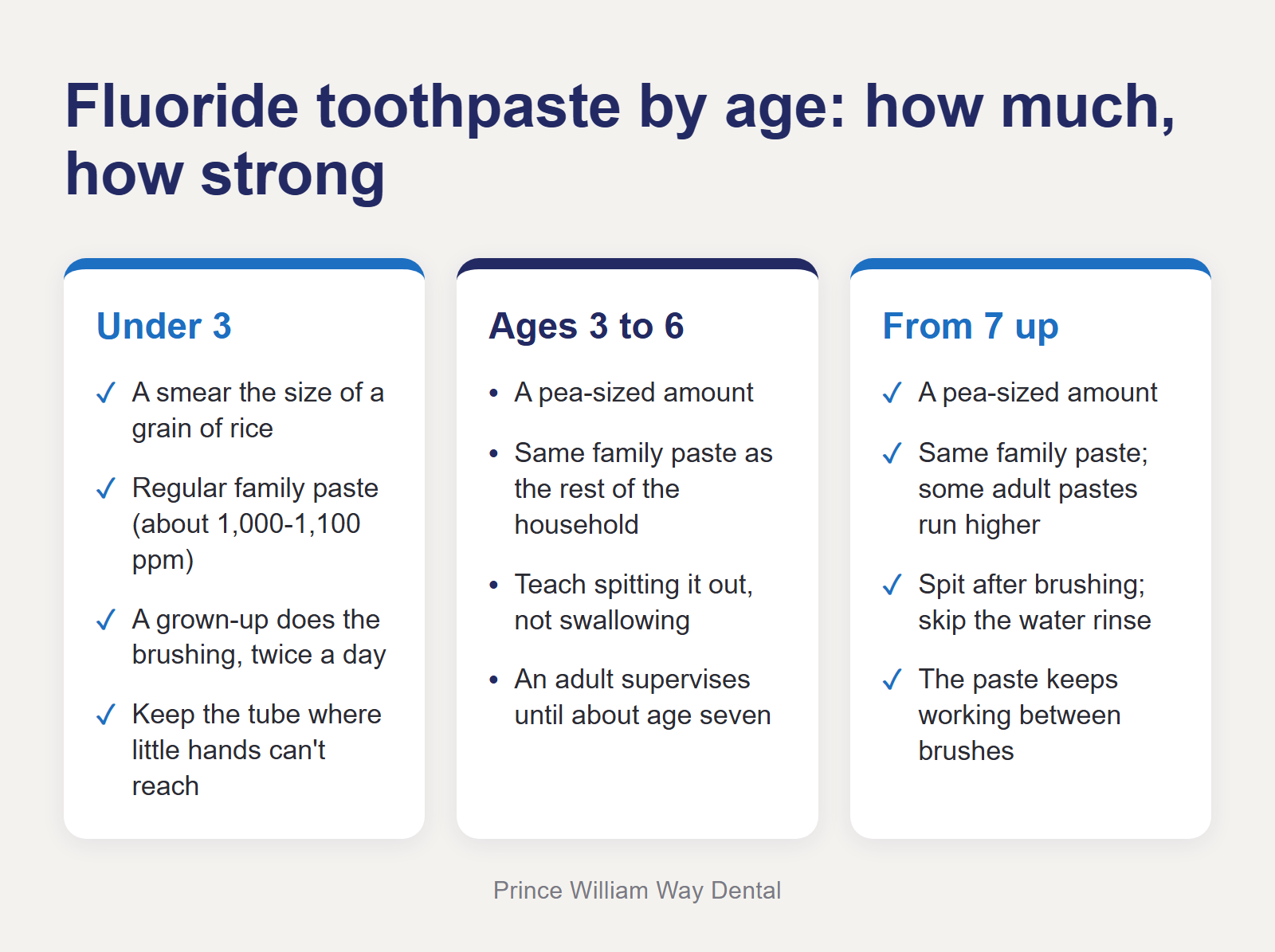
| Age | How much paste | Which paste |
|---|---|---|
| Under 3 years | A smear the size of a grain of rice | Regular family paste (about 1,000 to 1,100 ppm) |
| 3 to 6 years | A pea-sized amount | The same family paste; an adult brushes or supervises |
| 7 years and up | A pea-sized amount | The same family paste (some adult pastes run higher, around 1,450 ppm) |
A few habits do most of the protecting: brush your child’s teeth for them, or closely supervise, until they can do it well themselves — usually around age seven; encourage them to spit rather than rinse; and keep the tube out of reach so it isn’t eaten or licked. If your child is at higher risk of decay we sometimes suggest a slightly higher strength or more frequent varnish, but that’s a per-child call we’d make together at your child’s first visits with us.

What’s the fluoride we paint on at the practice?
That’s fluoride varnish — a sticky, concentrated coat we brush onto the teeth in a few seconds. It’s a much higher concentration than toothpaste, but because it’s a tiny, controlled amount that sets on contact, very little is swallowed, which is why it’s the one strong fluoride we can safely use even in preschoolers. We’d usually apply it two to four times a year for children at higher risk of decay, and it’s been shown to reduce cavities in both baby and adult teeth. The only aftercare is not eating or drinking for about half an hour so it can do its work.
So what are the honest pros and cons?
The honest balance sheet on fluoride is short: the evidence that it prevents cavities is strong, and the genuine downsides are few and manageable.
Pros: it’s one of the best-evidenced ways to prevent cavities; it works on contact, so brushing and varnish deliver most of the benefit; it helps rebuild early, still-reversible enamel damage before it becomes a hole; and at brushing amounts the safety record is long and reassuring.
Cons: it’s not a substitute for cutting down on frequent sugar; and in early childhood, too much while adult teeth are forming can cause mild cosmetic marks — a real but avoidable trade-off that comes down to using the right amount and supervising young children.
Put simply, the “con” is a reason to get the amount right, not a reason to avoid fluoride. For most people, a fluoride toothpaste twice a day is enough, and it’s one of the highest-value few minutes you’ll spend on your health all day.
When to just ask us
If you’re weighing bottled versus tap water for a toddler, wondering whether your family needs a stronger paste, or unsure what white marks on a child’s new teeth mean, those are questions worth a quick conversation with us. A white mark can be early fluorosis, an old spot of enamel that formed unevenly, or the very first sign of decay — and which one it is isn’t something to settle from a photo or a description; it takes a proper look. We’ll fit you in as soon as we can and tell you plainly what we see.
If you’d like to sort out the right fluoride routine for yourself or your kids, our family-run team at Prince William Way Dental in Barrie is glad to help — evenings and Saturdays, direct billing, and CDCP accepted. Call 705-721-9229 or book online — online booking covers new patient visits and emergency examinations. For anything else, reach us through our contact page.
This guide is part of our Adult Patient Information library, where you’ll find the rest of our guides on prevention, everyday dental care and common problems.
Need to see a dentist? Call us at 705-721-9229.
New Patient or Dental Emergency? Book Online!