This article is general information for our patients, not a diagnosis. If something in your mouth hurts, changes, or worries you, have it examined.
Few dental words make people flinch like “root canal,” and most of that comes from old stories rather than the treatment as it is today. Here’s how I’d walk you through it in the chair.
One thing up front. The symptoms below are clues, not verdicts — each one points somewhere, but on its own it can mislead. Whether a tooth truly needs a root canal comes down to what pulp testing and an X-ray show once they’re set beside your history and a hands-on exam: how the nerve answers cold, whether it hurts to tap on, whether infection has reached the bone at the root tip. A nerve that seems doomed from one symptom can test perfectly healthy, and a tooth that’s gone quiet can turn out to be dead — so the verdict waits on those tests, not the symptom. Assembling that is the part we do in the chair.
What a root canal is, and what it’s for
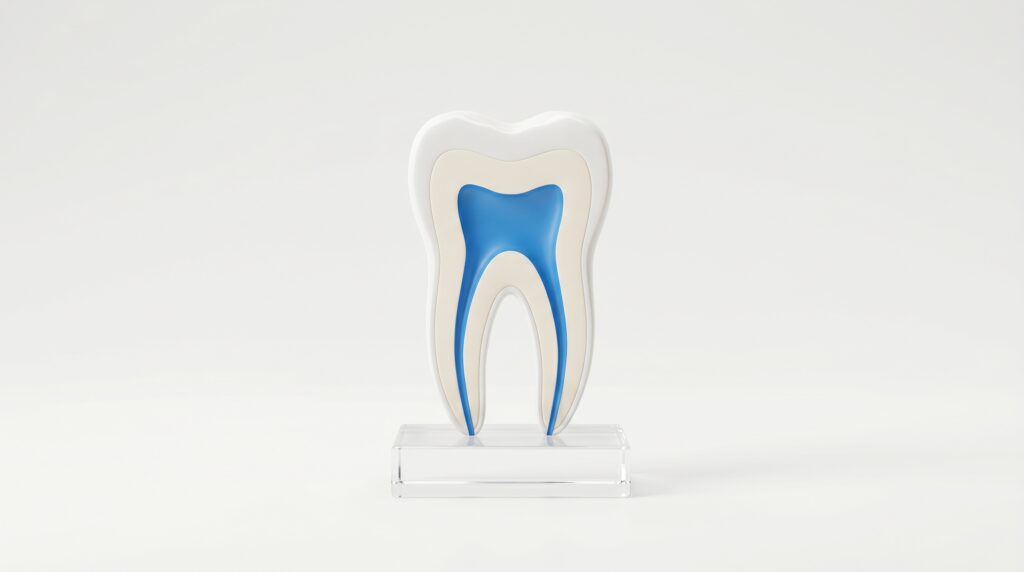
Under a tooth’s hard outer layers sits a soft core of nerves and blood vessels (the pulp — most people just say the nerve, so I will too). It runs down narrow channels inside each root, the root canals, which is where the treatment takes its name. A healthy nerve keeps the tooth alive and lets it sense hot and cold. Once it’s badly damaged or infected it can’t repair itself, and left alone it tends to bring pain and, in time, the loss of the tooth.
A root canal (your dentist may call it endodontic treatment — “endo” means “inside”) treats the inside of the tooth instead of taking the whole tooth out. We clear the unhealthy nerve, disinfect the canals and seal them. The part you chew and smile with stays put.
Why a tooth may need one
A tooth tends to need a root canal when the nerve is inflamed beyond healing or has died — usually from deep decay, a crack or an injury. It helps to picture a progression rather than a single event.

- An irritated nerve that can still recover (reversible pulpitis). A quick twinge from cold, hot or sweet that’s gone within seconds. This often points to a nerve that’s only irritated — a filling can frequently calm it, no root canal needed.
- Inflammation past the point of return (irreversible pulpitis). When the irritation keeps up — deeper decay, a leaking filling, a crack — the pain tends to linger for minutes after the trigger, come on by itself, and feel worse lying down at night. This pattern is the most common reason we end up recommending a root canal, though it’s the tests and X-ray that confirm it.
- A dead nerve, then an abscess (a pocket of infection). Left long enough the nerve dies, and the tooth may go quiet for a while. The bacteria don’t stop, though — they travel out the root tip into the bone, where infection can build into an abscess with swelling, a bad taste, pain on biting, or a gum “pimple” that weeps. This is where things can turn urgent. Facial swelling, a fever, or pain you can’t control is the point for our emergency dental care in Barrie; here’s what a dental abscess feels like and when it is an emergency.
So by the time I’m recommending a root canal, it’s usually because the whole picture — not one symptom — points to a nerve past healing or already dead. The realistic choice then is to treat the inside of the tooth or remove it, and I weigh that with you in deciding between saving a tooth and taking it out.
What actually happens during the treatment
We numb the tooth, isolate it behind a thin rubber sheet, clean and shape the canals, then fill and seal them — usually over one or two visits.

- Numbing. The same freezing you’d have for a filling. We don’t start until you’re comfortable.
- Isolating the tooth. A rubber dam — a thin latex-free sheet — goes over the tooth so only it pokes through. This keeps the canals dry and free of saliva and its bacteria, and keeps small instruments and rinses away from your throat. Keeping the area clean is a big reason modern root canals do as well as they do.
- Opening the tooth. A small opening through the biting surface reaches the canals. Front teeth usually have one canal; back teeth often have two to four, which is why they take longer.
- Cleaning and shaping. Fine flexible files clean the dead or infected tissue from each canal. I measure each canal’s length — to the root tip, not beyond — with a small electronic gauge, often double-checked on an X-ray, and rinse throughout with a disinfecting solution (a dilute, dental-strength relative of household bleach) that reaches what the files can’t.
- Filling and sealing. Once the canals are clean, dry and shaped, I fill them with a soft rubbery material (gutta-percha) and a sealer so bacteria can’t easily move back in.
- Rebuilding the tooth. I close the opening with a filling — on back teeth, usually a temporary step until the crown.
Badly infected teeth are sometimes treated over two visits, with a medicated dressing sealed inside between them; single-visit treatment is common too. I’ll tell you which is likely before we start.
Does a root canal hurt — during and after?
With the tooth properly frozen the treatment itself shouldn’t hurt; afterward it’s often tender for a few days and tends to settle on its own.
During: once numb, most people feel pressure and vibration rather than pain — much like a filling. The fair caveat is that a badly infected tooth can be harder to freeze fully, so now and then I add more or change approach to get you comfortable. If dread of the chair has kept you away, tell me — we go at your pace, explain before we treat, and take breaks whenever you need them.
After: the tooth and gum often feel tender or “bruised” for a few days, especially biting — that’s the area healing. Most people manage that soreness with painkillers bought from the pharmacy, and a pharmacist can advise which ones suit you if you’re on other medicines or live with a health condition. The soreness usually fades within a few days to a week, though a smaller number get a sharper flare-up early on. What isn’t expected is pain that keeps climbing, swelling of the face or gum, or a fever — call us if any of those show up.
| Normal after a root canal | A reason to call us |
|---|---|
| Tenderness or a “bruised” feeling for a few days, worse when you bite | Severe pain that keeps climbing instead of easing |
| Soreness that fades within a few days to a week | Swelling of the face or gum, or a gum “pimple” that weeps |
| A mild flare-up in the first day or two, eased by over-the-counter painkillers | A fever, or pain you can’t control |
How many visits does it take, and how long?
Most root canals take one or two visits of about 60 to 90 minutes, depending on how many canals the tooth has and how infected it is. A single-canal front tooth is quicker; a back tooth with several curved canals takes longer and may be split over two appointments. The permanent crown on a back tooth is usually a separate, later visit. For especially tricky teeth — very curved or narrowed canals, or a re-do of a previous root canal — I may refer you to an endodontist, a dentist with years of extra training on the inside of teeth.

Does the CDCP cover a root canal?
For eligible patients, the Canadian Dental Care Plan (CDCP) does include root canal (endodontic) treatment among the services it helps toward — it isn’t cosmetic, it’s saving a tooth. What the plan pays is a share of a set CDCP fee, and the share depends on your household income, so a portion may still be yours to cover; pre-authorization is sometimes needed for the more involved teeth. The simplest thing is to let us check your specific coverage before we start — our team handles the CDCP paperwork with you and gives you a written estimate of any remaining cost, so there are no surprises. Many private insurance plans cover root canals too. If cost is the reason you’ve been putting a sore tooth off, phone us on 705-721-9229 and we’ll sort out the coverage side first.
On fees generally: the amount depends on the tooth and how many canals it has, and you’ll always get that estimate in writing before anything begins.
Does the plan cover the crown afterwards?
Often, yes — a crown after a root canal is treatment the Canadian Dental Care Plan can help toward, but crowns carry their own criteria and usually need the plan’s approval before we start. That is the part worth knowing early, because the crown and the root canal are treated as two separate questions by the plan even though clinically they are one job: the treatment that saves the tooth, and the cover that stops it splitting afterwards. What decides it is the state of the tooth — how much solid structure is left and whether a simpler repair would hold. We submit the case and the x-rays, and you get the plan’s position in writing before we book the crown. Call us at 705-721-9229 or book online, and for who qualifies and how the plan works overall, see the Canadian Dental Care Plan explained.
How well do root canals work?
Re-examined a few years on, roughly 66% to 95% of root canals are judged successful — the range is wide mostly because studies define “success” differently, but the large majority of teeth pass. Survival, how long the tooth actually stays in, is the longer question: one large US study of more than 70,000 treated teeth found half still working after about 11 years, and around a quarter (26%) past 20 years. The teeth lost early were very often the ones never properly rebuilt — which is where the crown comes in.
It isn’t a sure thing, and I won’t pretend otherwise. A root canal can fail — usually if bacteria survive in a hard-to-reach canal, get back in through a leaking filling, or the tooth later cracks. The options then are re-treatment, a minor procedure on the root tip, or removing the tooth.
Why do I need a crown afterward?
A back tooth tends to turn more brittle after a root canal, so a crown — a cap over the whole tooth — is usually needed to keep it from splitting under the heavy forces of chewing. This is the step most often skipped, and skipping it is the most common way a good root canal is lost. Front teeth take gentler forces and often do well with a bonded filling instead.
The numbers are striking, which is why I push the conversation: a crowned back tooth stays in place in roughly 94% of cases at five years, against about 63% with a filling alone — a gap that comes down to teeth cracking.
| After a root canal | What the studies suggest for keeping the tooth |
|---|---|
| Back tooth with a crown over the whole biting surface | Around 94% still in place at five years |
| Back tooth left with a filling only | Around 63% — many more split and are lost |
| Front tooth (often no crown needed) | About the same either way |
The sooner the crown goes on, the better: back teeth crowned within about four months are roughly three times less likely to be lost than those left longer, since waiting leaves the tooth open to a fracture or a leak that re-infects the work. The crown is the part that makes the whole treatment last.
Are root canals bad for my health?
No. The idea that root canals cause disease elsewhere in the body traces to a “focal infection” theory from the 1920s — that a treated tooth could seed infection into the heart, joints or other organs. Researchers were dismantling it by the 1930s, and the American Association of Endodontists is clear there’s no valid scientific evidence linking a properly done root canal to cancer or disease elsewhere. What we’re actually treating is a real infection inside the tooth; leaving a dead, infected nerve in place is the genuine health concern. If something you’ve read gave you pause, ask me — I’d far rather talk it through.
This guide is part of our Adult Patient Information library.
And if anything here sounds like your tooth, you’re welcome to book through our contact page — we’ll take a proper look, read the whole picture together, and lay out your options without pressure.
Need to see a dentist? Call us at 705-721-9229.
New Patient or Dental Emergency? Book Online!