This article is general information for our patients, not a diagnosis. If something in your mouth hurts, changes, or worries you, have it examined.
“You need this tooth out” makes almost everyone tense up — but for most people the visit is more straightforward than they fear. Below I’ll walk through what actually happens, how we keep you comfortable, how to heal well, and the risks worth knowing. If you’re wondering whether the tooth can be kept instead, whether to save a tooth or take it out explains how I weigh that call.
Before we go further, there’s a point I won’t skip past. Whether a tooth truly needs to come out — and how it will come out, and what your particular risks are — isn’t something I settle from a single symptom or a quick glance. It emerges from weighing three things against each other: your history, what the exam shows, and the X-ray (sometimes a 3D scan). Any one of those alone can point the wrong way; it’s the full set, read together, that settles it — and that part happens in the chair.
What happens when a tooth comes out
An extraction is the removal of a tooth from its socket: we numb the area, gently widen the socket and ease the tooth free, so what you feel is firm pressure and rocking, not cutting. Most simple extractions take only a few minutes.
Some teeth lift out whole and quickly. Others — badly broken-down teeth, curved roots, or wisdom teeth that are still partly buried — may need a “surgical” extraction: lifting the gum a little, sometimes removing a small amount of bone or dividing the tooth so it comes out cleanly. It sounds dramatic, but it’s done under the same freezing and is often gentler on the bone than forcing a stubborn tooth. Which approach a tooth needs is usually clear from the X-ray, and I’ll talk you through the plan first.

Will I be awake, and will it hurt?
You stay awake for most extractions, but the area is fully frozen, so you feel pressure rather than sharp pain. The freezing (local anaesthetic) blocks the nerve to that tooth and gum. You’ll still feel pushing, pulling and the sounds of it — those signals travel differently — but the sharp pain should be gone. Feel anything sharp at any point? Lift your hand and I’ll add more.
If dentistry genuinely stresses you, say so before we begin. We work at your pace, tell you what is about to happen before it happens, and stop the moment you raise a hand.
I can’t promise you’ll feel nothing at all, but sharp, uncontrolled pain isn’t something you should accept — tell us, and we adjust.
Looking after the socket afterward
For the first 24 hours, the job is to protect the blood clot in the socket — it’s the foundation your gum and bone heal over.
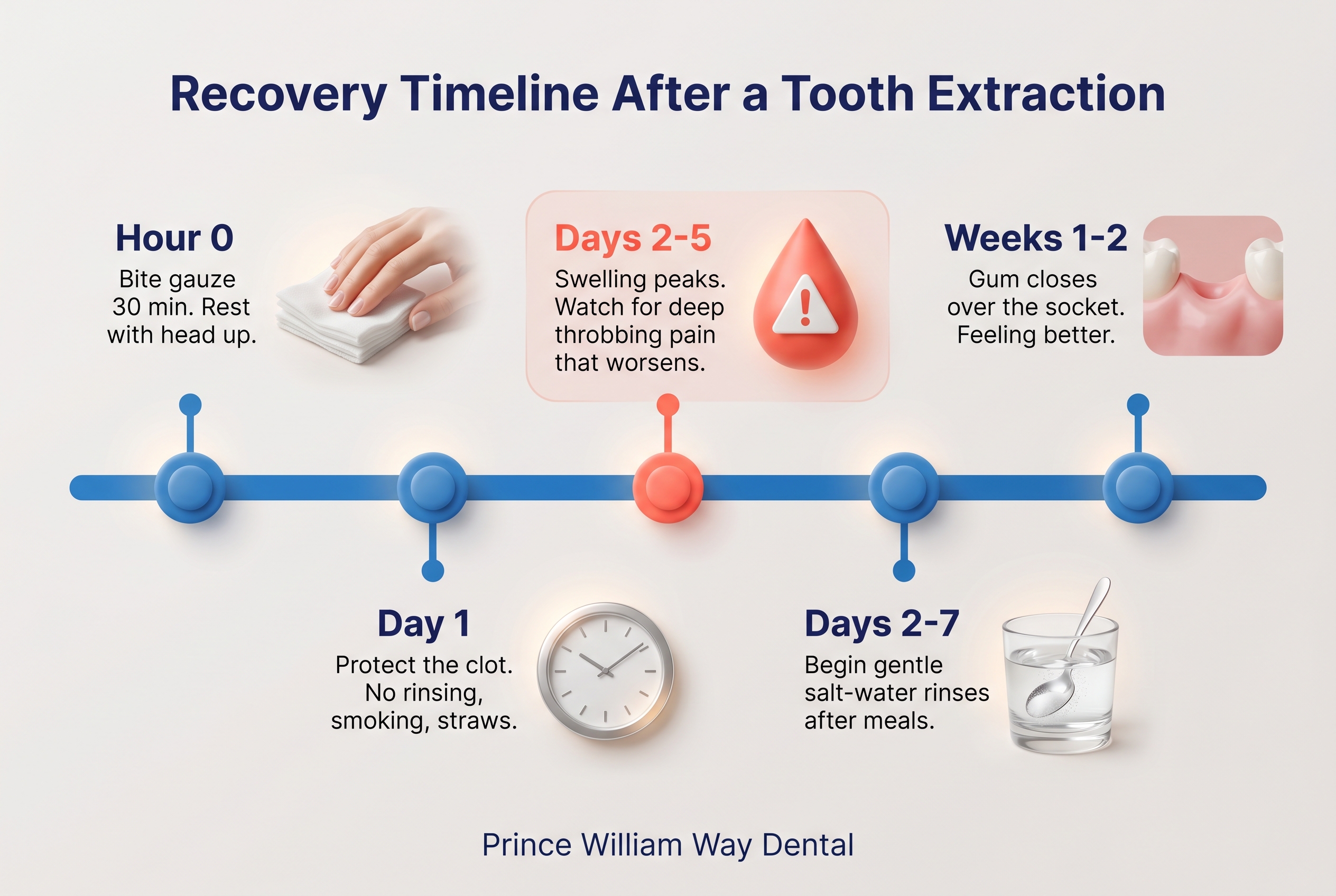
The first 24 hours
- Bite on the gauze for a full 30 minutes by the clock — no peeking, no spitting; a clot needs that long of uninterrupted pressure to settle. Still oozing? Fresh gauze, bite another 30.
- Rest, head up. Take it easy, prop your head on an extra pillow that night, and skip the gym, heavy lifting and hot baths.
- Leave the area alone. No rinsing, swishing or poking the socket; no smoking, vaping, alcohol or straws — suction can pull the clot straight out.
- Eat soft and lukewarm. Yogurt, scrambled eggs, mashed potatoes, lukewarm soup, a spooned smoothie. Chew on the other side.
- Ease discomfort early. Some soreness as the freezing fades is normal. A standard over-the-counter painkiller usually settles it; ask your pharmacist which one suits you, particularly if other medicines are in the mix or you live with something like ulcers or asthma.
Days 2 to 7
- Start gentle salt-water rinses. From the next day, rinse with warm salt water a few times daily and after meals — let it fall out rather than swishing. This keeps the socket clean as the gum closes over.
- Brush as normal, just gently right around the socket.
- Expect swelling to peak, then settle, often around day 2 or 3.
- Watch which way the pain is heading. This is the window when a dry socket shows up — losing the protective clot too early, most often two to five days out and worst around day three. Ordinary healing eases a little each day; a dry socket flips that, so pain that climbs around day two or three, often with a foul taste, is the pattern to phone about. More on it below.
- Expect steady improvement. Most people feel noticeably better within a week, though a deeper surgical site or a wisdom tooth can take longer.
What can go wrong
Most extractions heal without trouble, but bleeding, swelling, infection, dry socket and — less often — nerve or sinus problems can happen. None of these is something to settle from a single sign; if anything below sounds like you, the safest move is to call and let us look.
| What tends to be normal healing | What’s worth a call |
|---|---|
| Oozing for a few hours; soreness as the freezing fades | Bleeding that soaks through gauze after 30 minutes of firm pressure |
| Swelling and bruising peaking around day 2 to 3, then easing | Swelling that spreads or keeps growing after day 3 |
| Steady improvement over the first week | Pain that gets worse after day 3, often with a foul taste |
| A small numb patch that fades as the freezing wears off | Numbness in the lip or tongue that hasn’t begun to fade within 1 to 2 weeks |
Bleeding. A little oozing for a few hours is expected. Some people get a second burst hours later, as the freezing — which also tightens the blood vessels — wears off. Same fix: sit up, fold clean gauze into a firm pad, bite on the socket for 30 minutes. If it keeps soaking through, call us.
Swelling and bruising. Common after surgical extractions and lower wisdom teeth. A cold pack on the cheek — 15 minutes on, 15 off — helps on the first day. Some jaw stiffness can follow and usually eases over several days.

Infection. Less common, and it tends to show up later — around days 5 to 10 — with increasing swelling, a bad taste or pus, sometimes a fever. This is different from the early soreness of healing and does need a look.
Dry socket. The one that catches people out. If the protective clot is lost too early, the bone underneath is left exposed — and the result tends to be a deep, throbbing ache, often spreading to the ear, that starts around day 2 to 5, is usually worst near day 3, and brings a foul taste. It follows roughly 2 to 5 of every 100 routine extractions, and as many as about 25 to 30 in 100 after a surgical lower wisdom tooth. Smoking is the biggest risk you can control — smokers get it several times more often — which is why I ask you not to smoke afterward. The reassuring part: it isn’t a true infection, it settles over a week or two, and a soothing dressing usually brings quick relief. More in dry socket — what it feels like and how we treat it.
Sinus opening (upper back teeth). The roots of upper molars sit close to the sinus, sometimes with only a wafer of bone between. Occasionally removing one leaves a small opening; signs can include air or liquid passing from the socket to your nose, or a salty taste. I check for this at the time and, if needed, place a stitch and give “sinus precautions”: no hard nose-blowing, sneeze with your mouth open, no straws for two weeks. Small openings usually close on their own.
Nerve problems (lower wisdom teeth). Two nerves run close to the lower wisdom teeth — one feeding the lower lip and chin, the other the side of the tongue. A tooth sitting right against one can bruise or stretch it when removed, leaving a patch of numbness or tingling. For most people this is temporary and recovers over weeks to months; lasting numbness is rare (well under 1 in 100), and the risk rises when the X-ray shows tooth and nerve touching. When it looks raised, I look closer first — sometimes with a 3D scan — and may suggest an oral surgeon, or leaving the deepest root tips rather than chasing them near the nerve. A good example of why the X-ray and exam, read together, decide the plan — not any one finding on its own.
Blood thinners and bone medicines
Usually you keep taking them — never stop a prescribed blood thinner or bone medicine on your own; tell us what you take and we’ll plan around it safely. Stopping a blood thinner without your doctor’s say-so can raise your risk of a clot, stroke or heart attack, which almost always outweighs the bleeding we can manage in the chair.
| Tell us if you take | Examples | Why it matters |
|---|---|---|
| Blood thinners | warfarin (Coumadin), apixaban (Eliquis), rivaroxaban (Xarelto), dabigatran (Pradaxa), clopidogrel (Plavix), daily aspirin | They raise bleeding risk. We usually keep you on them and use extra local measures (packing, a stitch, a clot-protecting mouthwash) |
| Bone-strengthening drugs | alendronate (Fosamax), risedronate (Actonel), zoledronic acid (Aclasta/Zometa), denosumab (Prolia) | A small but real risk of a jaw-healing problem; we may check with your doctor first |
| Drugs that slow healing or weaken infection defences | steroids, chemotherapy, anti-rejection medicines after a transplant | Healing can be slower and infection more likely, which changes the plan |
| Recent or planned cancer treatment | radiation to the head or neck, bone drugs given by vein (IV) | Higher risk of healing problems; the timing of any extraction needs care |
If you take warfarin, we often check a recent blood test (the INR, which shows how “thin” your blood is) and proceed without stopping it when the result is in a safe range. For newer thinners we sometimes just adjust a dose’s timing. Either way, you don’t leave until the bleeding is controlled.
The bone medicines deserve a word. Drugs for osteoporosis or some cancers slow the jaw’s natural ability to renew itself, and rarely a socket can struggle to heal — a condition called MRONJ (medication-related osteonecrosis of the jaw). For a weekly osteoporosis tablet that risk tends to be very low, no more than about 1 in 1,000; for cancer patients on IV bone drugs it’s closer to 1 in 100. Not a reason to avoid a needed extraction — leaving an infected tooth carries its own risk — but a reason to tell us, so we can work gently and coordinate with your doctor.
What happens to the bone afterward
Once a tooth is gone, the bone that held it slowly shrinks, the biggest change in the first year — which is why we raise replacement early. The socket fills in steadily: a clot in the first day, soft tissue over a couple of weeks, then new bone over the following months. But the ridge also narrows and lowers, because bone with no tooth to support tends to melt away — after a back tooth it can lose up to half its width in the first year, about two-thirds of that in the first three months.
Worth knowing now, even with a sore tooth on your mind, because the choices that preserve that bone are easiest before much shrinkage happens. No rush on the day, but it helps to know your options for replacing a missing tooth, from doing nothing to a bridge, denture or implant. If a denture is likely, dentures and the Canadian Dental Care Plan covers how the plan handles them.
Does the CDCP cover extractions?
It can, but it depends on your eligibility and your plan year. Extractions fall within the kinds of treatment the Canadian Dental Care Plan is built to help with, but whether yours is covered — and how much — comes down to your eligibility, the current plan year, and whether the plan wants the treatment pre-approved first. Rather than guess, call us at 705-721-9229 with your details and our team will check what applies and handle the paperwork with the CDCP on your behalf. For the bigger picture on who qualifies and how the plan works, see our guide to the Canadian Dental Care Plan. We also offer direct billing and accept the CDCP here in Barrie.
When to call us
Two slower signs deserve a call too: liquid or air moving between an upper socket and your nose, or numbness in your lip or tongue that hasn’t begun to fade within 1 to 2 weeks. Neither is a middle-of-the-night emergency, but both need a look. This guide is part of our Adult Patient Information library.
If a tooth is troubling you, or you’ve been told one needs to come out, we’re glad to take a look and talk it through. Reach our Barrie practice at 705-721-9229 or book online — online booking covers new patient visits and emergency examinations. For anything else, reach us through our contact page.
Need to see a dentist? Call us at 705-721-9229.
New Patient or Dental Emergency? Book Online!