This article is general information for our patients, not a diagnosis. If something in your mouth hurts, changes, or worries you, have it examined.
If you’ve had a tooth out and the ache is suddenly getting worse two or three days on instead of better, a dry socket is one of the first things I’d think of. Here’s how I tell it apart from ordinary healing, why it happens, and what we do about it. Up front: it’s treatable, it isn’t dangerous, and it doesn’t mean anything went wrong with your extraction.
A caveat before we get into the symptoms, and it’s an important one. The pain pattern below is a clue, not a verdict. Telling a dry socket apart from ordinary healing — or from an infection, or a leftover fragment of root — isn’t something a symptom checklist can settle on its own. It takes the whole picture, built up in the chair: how your recovery has gone since the extraction, what the socket looks like when I examine it, how the area responds to gentle testing, and an X-ray if there’s any doubt. A single symptom can point one way and mean another. So use what follows to judge how urgently to call, not to land on the answer yourself — that part happens when we look.
What’s actually happening
When a tooth comes out, a blood clot forms in the empty socket within the first hour or so. Think of it as a natural dressing: it seals the wound, shields the bone and nerve endings underneath, and gives new tissue a scaffold to grow into. In a dry socket — the clinical name is alveolar osteitis, meaning inflammation of the bony walls of the socket — that clot either never settles or breaks down within a few days, before the gum has taken over the job. The bare bone is left open to air, food and saliva, and exposed bone is genuinely sore. Worth saying plainly: a dry socket is not an infection, even though it can ache like one and leave a bad taste. That distinction changes how we treat it.
The pattern I rely on
Some soreness after an extraction is expected — a dull ache for a day or two, a little blood in the saliva for a few hours. The clue I lean on most is the direction of the pain. Ordinary healing eases a little each day. A dry socket tends to flip that: you feel reasonably comfortable at first, then around day two or three the pain climbs sharply and ordinary painkillers stop touching it.
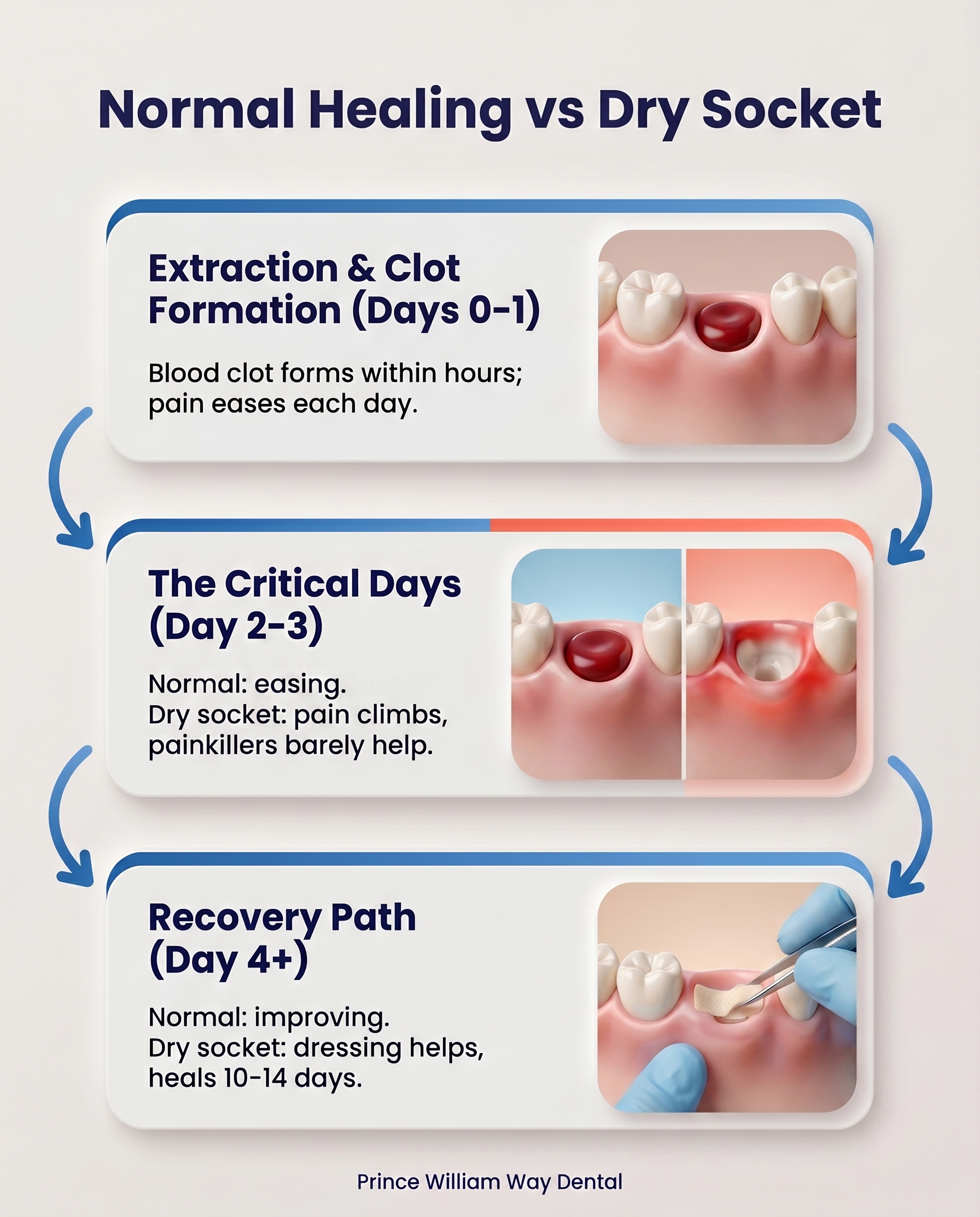
That direction — better versus worse — tends to be more telling than any single moment of pain. There’s a third possibility too, a truly infected socket, which behaves differently again and tends to bring swelling and fever. Here’s roughly how the three differ:
| Normal healing | Dry socket | Infected socket | |
|---|---|---|---|
| When pain peaks | First 24-48 hours, then eases | Climbs on day 2-3, then a dull ache | Often days 5-10 |
| Pain level | Eases with simple painkillers | Deep, throbbing, painkillers barely help | Throbbing, with pressure |
| The socket | Dark clot sitting in place | Empty-looking, greyish, clot gone | Pus, redness around the gum |
| Smell or taste | Normal | Often a bad taste or odour | Bad taste, sometimes pus |
| Fever or swelling | No | No | Often yes |
No single row is a diagnosis on its own — an empty-looking socket can mislead — but read alongside the timing and how the area responds, the rows point somewhere. If you have fever, facial or jaw swelling, or a bad taste with pus, that points away from a simple dry socket, and I’d want to see you promptly through Barrie emergency dentist.
How painful is a dry socket?
Honestly, it’s one of the more uncomfortable things that follows a routine extraction — patients often describe it as worse than the toothache that sent them in for the tooth in the first place. It’s a deep, throbbing ache rather than a sharp jab, and it tends to radiate along the jaw toward the ear, the temple, or the side of the neck, so it can feel bigger than the small socket it comes from.
I’d steer you away from putting a number on it, though. What tells me more than “how bad out of ten” is the character of the pain and, above all, its direction. A dry socket’s pain is typically constant, worse than you’d expect from how the socket looks, and — the part that matters most — climbing rather than fading. Ordinary painkillers barely take the edge off, and it often disturbs sleep. Those features, together, are the clue. Plenty of things can hurt “a lot”; it’s the deep, radiating, worse-each-day quality that points toward a dry socket rather than settling soreness. So use the severity to judge how soon to call — if the pain is bad enough to keep you up or stop you eating, that alone is worth a phone call — not to self-diagnose. The look in the mouth is what confirms it.
When it tends to show up
A dry socket usually announces itself two to five days after an extraction, most often around day three — once the clot has broken down. Pain in the first 24 hours is more often just normal post-extraction soreness. That middle window is part of why timing helps me: pain landing just when you thought you were through the worst points more toward a dry socket than toward either fresh soreness or a later infection. Left alone, the worst of it tends to hold for several days, then fade as new tissue creeps in from the gum edges; even untreated, most settle within about ten to fourteen days. Which is why the answer to “when am I safe?” is mostly the calendar: once you are past about day five with no sign of it, a dry socket is unlikely to start late, and by the end of the first week you are through the window it lives in. You don’t have to ride it out, though — most of what treatment does is get you through the painful patch sooner.
A day-by-day timeline: what to expect
People phone worried on very specific days — “it’s day three and it’s worse,” “it’s day five and there’s a taste” — so here’s the rough arc, both for normal healing and for a dry socket. Everyone heals at their own pace, and these are general patterns, not a schedule your mouth has to follow.
| When | Normal healing | If it’s a dry socket |
|---|---|---|
| Day 1 (first 24 hrs) | Some oozing, then a dull ache that eases; a dark clot sits in the socket | Usually still settling — pain this early is more often ordinary soreness |
| Day 2 | Noticeably more comfortable; swelling may peak, then start to fall | The ache may stop easing and begin to build — the first hint something’s off |
| Day 3 | Clearly on the mend, painkillers rarely needed | The classic day for it to announce itself: deep, throbbing pain that climbs, painkillers barely touch it, often a bad taste |
| Day 5 | Socket edges closing over; only mild tenderness | Pain often still there but starting to plateau; a lingering foul taste is common. (Fever, swelling or pus here points more toward infection — call us) |
| Day 7–10 | Gum tissue well on the way to covering the socket | Even untreated, the worst usually begins to fade as new tissue grows in |
| Day 10–14 | Comfortable; socket largely healed over | Most dry sockets have settled by now, treated or not |
The single most useful reading isn’t any one day’s pain level — it’s the direction between days. Getting better each day is reassuring; getting worse around day two or three is the pattern worth a phone call.
Why it happens, and who’s more prone
Behind a dry socket is the body’s normal clot-dissolving process (fibrinolysis) kicking in too soon, in the wrong place — or the clot being physically disturbed. A few things raise the odds:
- Smoking and vaping. The biggest factor you can control: the chemicals cut blood flow to the healing site, and the suction can physically pull the clot out. Smokers get dry socket roughly three times as often as non-smokers.
- The combined birth control pill. The estrogen nudges up clot-dissolving activity; if you take it, scheduling the extraction for the pill-free week can help — worth mentioning to us.
- A difficult or surgical extraction. The more the bone is disturbed — removing a tooth in sections, or one buried in the bone (impacted) — the higher the risk.
- Lower back teeth, especially wisdom teeth. The lower jaw is denser bone with a poorer blood supply, so lower molars carry a higher rate, and a surgical lower wisdom tooth is the highest-risk site of all — one reason wisdom teeth and the gum infection called pericoronitis come up together so often.
- A previous dry socket. Having had one is the strongest single predictor of another, so tell us.
- Rinsing, spitting or hot drinks too soon, and a pre-existing infection or poor cleaning around the tooth also play a part.
To put numbers on it: after a routine extraction the risk is low — roughly 1 to 3 percent of upper-tooth extractions and 2 to 5 percent of lower. For a surgically removed lower wisdom tooth it’s far higher, around one in four (25 to 30 percent). Most extractions, though, heal with no trouble at all.
What we do about it
A dry-socket visit is a gentle one, and relief from the dressing is often quick. Roughly what to expect:
- A quick check. I confirm it’s a dry socket and not something else — occasionally with an X-ray if there’s any question of a leftover root fragment. Knowing what you’re dealing with takes a lot of the worry out.
- A gentle wash-out. I flush the socket with warm salt water or an antiseptic rinse (chlorhexidine) using a soft syringe, to clear trapped food and debris. I don’t scrape the bone — that only makes it worse.
- A medicated dressing. I pack the socket loosely with a soothing dressing (commonly one called Alvogyl) that contains a mild numbing medicine and antiseptic. It forms a comforting barrier over the exposed bone while new tissue grows in underneath, and many people feel the difference quickly. It’s usually changed every two to three days until the pain has gone.
- A pain-relief plan. Staying ahead of the pain works far better than chasing it, so I’ll usually suggest taking something on a regular schedule for a couple of days rather than waiting for it to break through.
One thing I’m deliberate about: I don’t reach for antibiotics for a straightforward dry socket. They don’t speed healing here, and a dry socket isn’t an infection. If there are genuine signs of infection — fever, swelling, pus — that’s a different situation, and antibiotics may then have a role.

Will it clear on its own?
It will — a dry socket heals by itself in about ten to fourteen days, and there’s no lasting harm in waiting it out. The bone isn’t “dying,” the extraction hasn’t failed, and the gum closes over and heals normally in the end. The reasons to come in are comfort and certainty: a dressing can turn a miserable few days into something manageable, and a quick look lets me rule out a leftover root fragment or an early infection that only looks like a dry socket. If you’d rather ride it out, regular painkillers and gentle warm salt-water rinses will get you there — it just takes longer to feel comfortable.
Lowering the odds
Nearly all of preventing a dry socket comes down to shielding that first clot, and nearly all of that falls to you once the appointment is over. No measure removes the risk entirely, but these genuinely lower it.
| Do | Don’t |
|---|---|
| Bite firmly on the gauze pad for a full 20-30 minutes | Don’t keep lifting the gauze to peek — that restarts the bleeding |
| Rest with your head propped up for the first day | Don’t smoke or vape, ideally for several days; even 48 hours helps a lot |
| Stick to soft, lukewarm food for a day or two | Don’t rinse, spit forcefully, or use a straw for the first 24 hours |
| Start gentle warm salt-water rinses from the day after | Don’t poke the socket with your tongue or a finger |
| Take painkillers as we advise and keep the area clean | Don’t drink alcohol or hot drinks on the first day |
On our side, a careful, unhurried technique helps, and an antiseptic rinse just before an extraction cuts the risk of dry socket roughly in half in clinical trials. If you smoke, even a 24-to-48-hour break before the appointment makes a dry socket about half as likely, and staying off for a few days afterwards protects the clot while it’s most fragile. If you’ve had a dry socket before, or you’re having a lower wisdom tooth out, tell us — we can place a protective dressing at the time as a precaution. For the bigger picture beforehand, our guide on what to expect when a tooth is taken out walks through the whole process.
When to call us
Worth a phone call: pain that climbs after day two, a foul taste or smell, or fever, swelling, or bleeding that won’t stop. The one I’d underline is the first — pain that climbs instead of easing two or three days on is the classic dry-socket pattern, and the sooner we see it, the sooner a dressing can settle it. For bleeding, bite firmly on clean gauze for 20 to 30 minutes first; if it still won’t settle, that earns a call too. None of these is an emergency in the life-threatening sense, but all of them are things we’d rather sort out than have you endure at home.
If any of that sounds like you, please reach out — call us on 705-721-9229 or book an emergency examination online, and we’ll get you seen and comfortable. A dry socket is a common, well-understood bump in the road after an extraction, and one we handle routinely here in Barrie.
This guide is part of our Emergency Patient Information library, where you’ll find the rest of our guides on extractions, healing and everyday dental problems.
Need to see a dentist? Call us at 705-721-9229.
New Patient or Dental Emergency? Book Online!