This article is general information for our patients, not a diagnosis. If something in your mouth hurts, changes, or worries you, have it examined.
A tooth that twinges on a cold sip or a hard bite in the days after a filling unsettles plenty of people — understandably. Most of the time, though, it’s the tooth settling rather than a filling gone wrong. Below I’ll walk through why it happens, how long it normally runs, what helps, and the signs that earn a second look.
A word before we start. Every sensation described below is a clue, not a conclusion. From your side of the mouth, a tooth that’s quietly settling and a bite that needs a quick adjustment can feel almost identical — the same cold twinge might trace back to a nerve calming down or to a filling left a hair too tall. Sorting one from the other takes the whole account: what you tell me, a hands-on exam, how the tooth answers a cold test and a tap on one cusp, and an X-ray to see what’s happening beneath the surface. So treat what follows as a way to understand your tooth and judge how soon to act — not to pin down the cause yourself. Pinning it down is my job, in the chair.
Why a filled tooth feels sensitive at all
When we place a filling, the tooth is numbed, cleaned, dried, and rebuilt, and the freshly treated surface needs a little time to calm down. A short, sharp “zing” to cold or air that’s gone in a second or two is the typical pattern — it comes from the tooth’s outer layers rather than deep damage, which is why it eases a little more each day. What I watch is the trend: sensitivity that shrinks day by day is reassuring; sensitivity that grows, spreads, or starts arriving with no trigger is the kind I want to know about.
Four causes I sort between
When a patient describes post-filling sensitivity, I’m usually weighing one of four causes — a bite that sits high, a freshly exposed inner layer, a deep filling near the nerve, or the bonding settling in. They can overlap, and each behaves a little differently.
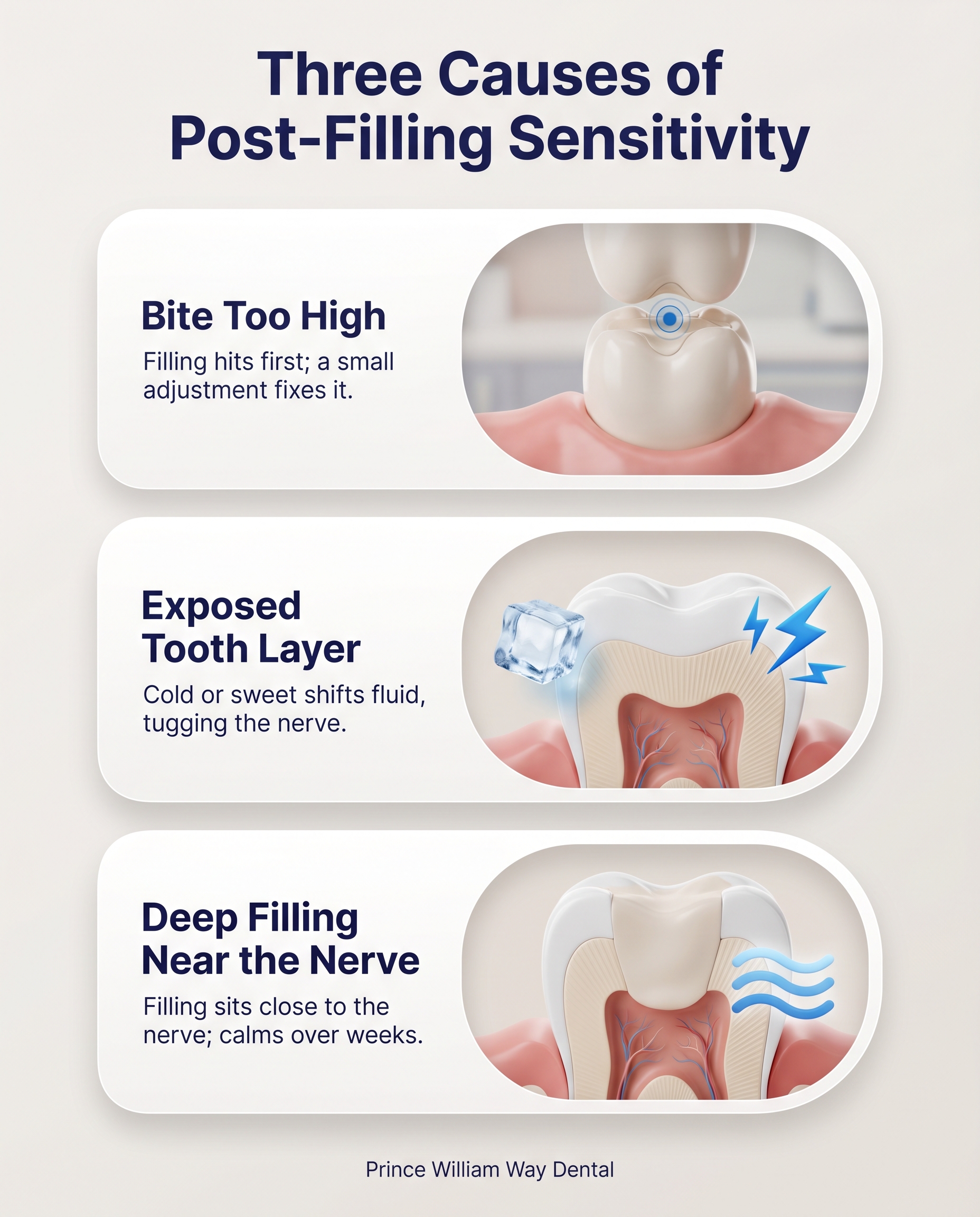
A bite that sits a little high. We shape a filling to match your tooth’s height by feel and with thin marking paper — while you’re still partly numb and not closing quite as usual. If it ends up even a fraction of a millimetre too tall, that tooth meets its partner first every time you close and takes more force than it should: soreness on biting, a tooth that feels “different,” sometimes an ache that builds through the day. A high bite tends to be the most common cause of biting pain after a filling, and it’s also the quickest to settle — a small adjustment usually does it within a day or two. If biting stays tender after I’ve checked the height, the cause is sometimes grinding or a hidden crack rather than the filling.
A freshly exposed inner layer. Under the hard enamel sits a softer layer (dentine). It isn’t solid — it’s packed with thousands of microscopic tubes running inward toward the nerve, each filled with fluid. When cold, air, or something sweet reaches it, that fluid shifts and tugs on the nerve, and you feel a quick, sharp pain — the same reason exposed roots and worn teeth feel sensitive. A new filling can leave this layer briefly more reactive until it settles or we seal it over.
A deep filling near the nerve. If the cavity was deep, the base of the filling ends up close to the soft core of nerves and blood vessels at the tooth’s centre (the pulp). A nerve that’s been irritated but not seriously harmed becomes briefly inflamed — grumbling, but expected to recover (reversible pulpitis) — reacting more to cold and sweet for a while, then quietening as the tooth lays down a fresh protective layer inside over the following weeks. That’s what happens with most deep fillings. In a smaller share — on the order of one in ten — the nerve was already too damaged to recover, and the tooth goes on to need root canal treatment.
The bonding settling in. Most fillings today are tooth-coloured (composite), bonded into the tooth with an adhesive that locks into those tiny tubes and seals the surface. It needs the tooth kept clean and dry while it sets, and it shrinks very slightly as it hardens, which can stress the join — either can leave a tooth briefly sensitive to cold and pressure. Older silver fillings (amalgam) carry temperature quickly, so those teeth can feel cold-sensitive in the early days too.
How long it should last
Most post-filling sensitivity fades within a few days and is gone by two to four weeks, with the deepest fillings needing the most time. A small, shallow filling might feel normal again within days; a deep one near the nerve can take the full four weeks while the nerve calms and rebuilds. Throughout, the trend should be downward — less often, less sharp, easier to ignore. My rule for patients: as long as it keeps easing and settles inside that window, leave it be; if it stalls by two weeks, is still hanging on at four, or starts heading the wrong way, the tooth has earned a phone call.

The simplest way to tell a settling tooth from a struggling one is to compare what you’re feeling against this — but remember no single row is the answer; it’s the overall picture, read with an exam and an X-ray, that settles it:
| What you notice | Usually settling | Worth calling us about |
|---|---|---|
| What sets it off | Cold, sweet, or biting | Pain that arrives with no trigger |
| How long the twinge lasts | Gone in a second or two | Lingers 30 seconds or much longer |
| Direction over time | Eases a little each day | Not improving by two weeks, or worse |
| At night | Doesn’t wake you | Wakes you or keeps you up |
| Other signs | None | Swelling, a bad taste, or throbbing |
Worth knowing why the tooth needed a filling in the first place: a cavity (dental caries) is bacteria turning sugar into acid that dissolves the tooth’s hard shell, and the deeper it reached before we treated it, the more irritated the tooth already was. So some tenderness afterward is often the tooth reacting to everything that happened before and during the repair — not a sign the filling went wrong. I tell the fuller story in what a cavity actually is.
The signs I want to hear about
The clues that point toward a nerve too inflamed to settle on its own (irreversible pulpitis) are pain that arrives with no trigger, throbs, lingers well past 30 seconds, wakes you at night, or comes with swelling or a bad taste. A short, sharp pain that fades within a second or two of removing the cold points toward a nerve that’s only irritated and expected to recover; pain that lingers, arrives on its own, or worsens when you lie down points the other way. Heat may set it off while cold briefly soothes it. None of these is a diagnosis by itself — but together, alongside an exam and an X-ray, they’re the picture that tells me to look soon rather than wait. Pain like that, or any facial swelling, means the tooth should be examined promptly, and when it flares after hours, our emergency dental care is for exactly that. A toothache that simply won’t settle has its own warning signs, which I cover in a toothache that won’t settle.
Settling it at home
While an ordinary tooth settles over the next two to four weeks, a few simple things genuinely help:

- Toothpaste for sensitive teeth (desensitizing toothpaste). It works by gradually blocking those tiny open tubes so the fluid inside can’t move as freely. Brush with it twice a day, and for extra effect smear a little onto the sensitive spot with a clean finger and leave it rather than rinsing straight off. Give it a week or two — it builds up rather than working instantly.
- Steer clear of the triggers you’ve noticed — very cold drinks, ice, sugary foods — so you’re not poking the tooth repeatedly.
- Chew on the other side for a few days if biting is tender, to take the load off while it recovers.
- When the tooth is really aching, an over-the-counter painkiller can quiet it down for a few hours. Ask your pharmacist which one suits you — that matters if you’re already on other medicines or you manage a health condition.
What none of this fixes is a filling sitting too high or a nerve that’s genuinely inflamed. So if two weeks of it brings no clear improvement, or things get worse, the tooth needs a hands-on look.
What we do in the chair
The first job is to find which cause is at play, because the fix follows the cause:
- Adjust a high bite — marking paper shows exactly where the filling hits too hard, and we smooth that contact. It’s quick, needs no needle, and often brings relief fast.
- Reseal or replace the filling — if the sensitivity is coming from a small gap or an old leaking filling, a fresh, well-sealed one usually solves it.
- Treat the nerve if it can’t recover — if the picture points to a nerve beyond healing, the tooth generally needs root canal treatment, which removes the damaged nerve and, in most cases, settles the pain and lets us keep the tooth. I’ll always talk you through it first.
- Removing the tooth is the last resort, kept for teeth too broken down or infected to save — not where we start, and most sensitive fillings never come near it.
I’d far rather you came in for a five-minute bite check that turns out to be nothing than sit at home guessing while a treatable problem grows.
How we try to prevent it
Lowering the odds of sensitivity is part of doing the filling well: keeping the tooth clean and dry so the bond seals with no gaps, sealing the freshly cut inner layer straight away to close off those open tubes, lining a very deep cavity to give the nerve an extra buffer, and checking your bite before you leave — with an open invitation back for a quick adjustment if it feels high once the numbness wears off. None of this makes a new filling immune to sensitivity; a tooth that’s been drilled and rebuilt is entitled to a few quiet days of complaint. But it makes the ordinary, settling kind more likely and the lingering kind less so.
Improving steadily and gone by two to four weeks is normal; not clearly improving by two weeks, or still there at four, call us. If the pain is getting stronger or keeping you up at night, please have it looked at rather than waiting it out. Reach our Barrie practice at 705-721-9229 or through our contact page, and we’ll get you booked in to find out exactly what the tooth needs. New patients and emergency examinations can also be booked online.
This article is part of our Adult Patient Information library.
Need to see a dentist? Call us at 705-721-9229.
New Patient or Dental Emergency? Book Online!